

Koottunkal K M Varghese a sketch by his grandson

This sketch was drawn by Boby Mathews in the year 1994
A boatyard at Pallippuram

Not far from NSS College Junction, there is a house boatyard on the bank of the eastern branch of Vembanadu lake. Here one can see house boats under repair and maintenance. This is a lucrative business in Kerala. The yard rent, repair costs, electricity etc are exorbitant in a common man's perspective. But of course, the business of tourism itself is very lucrative, isn't it?
It is a beautiful locality that gave me these snaps.


A coir mill on the shore

Nalpathenneeswaram grandpa tree
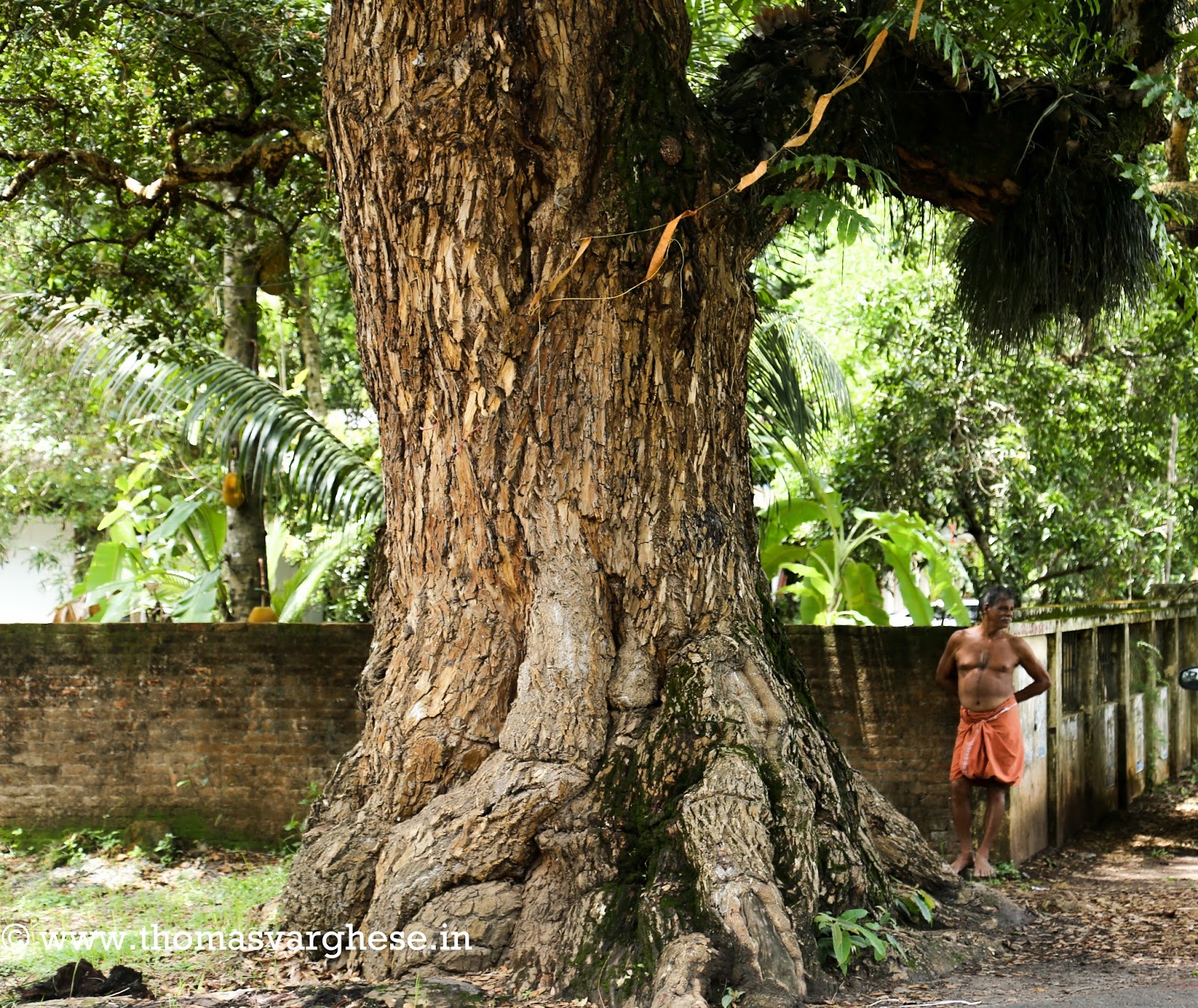
On the way to Nalpathenneeswaram temple near Poochackal, this wonder-tree stands tall bearing a history of many centuries. Taking refuge under the tree from the torturing summer heat, Velayudhan, a local from the neighborhood, said a few years ago forest department had conferred upon it the title of Grandpa Tree as it was the oldest tree in the district.

In those days when Velayudhan was a boy, there were only village pathways. No proper roads as we have today, he recollects. In their childhood, he and friends used to climb the tree for plucking punnappazham, its fruits. The tree had long hands-like branches that reached out to the ground. Anyone could easily climb up the tree through them. A few decades ago, these branches were cut off to pave way for the Panchayath road. The tree still has marks of the brutal attacks on it as one can still see stubs protruding like a war veteran's missing limbs.
Not surprisingly, the area has a sprawling population of punna trees, obviously the progeny of the grandpa tree. One of them has its branches spread over a field. It would be fun when the field is filled with rain water when one could dive from the tree and swim.

Silent spectators of time these trees are! A very long time and silence! What secrets would they reveal, if they could talk! What stories would they narrate!
The roads are still narrower here, and let us hope the development mantra will not be chanted here, lest these living monuments of an eventful past will be gone forever!
The grandpa tree
In those days when Velayudhan was a boy, there were only village pathways. No proper roads as we have today, he recollects. In their childhood, he and friends used to climb the tree for plucking punnappazham, its fruits. The tree had long hands-like branches that reached out to the ground. Anyone could easily climb up the tree through them. A few decades ago, these branches were cut off to pave way for the Panchayath road. The tree still has marks of the brutal attacks on it as one can still see stubs protruding like a war veteran's missing limbs.
Standing next to the tree is Velayudhan
Not surprisingly, the area has a sprawling population of punna trees, obviously the progeny of the grandpa tree. One of them has its branches spread over a field. It would be fun when the field is filled with rain water when one could dive from the tree and swim.
Silent spectators of time these trees are! A very long time and silence! What secrets would they reveal, if they could talk! What stories would they narrate!
The roads are still narrower here, and let us hope the development mantra will not be chanted here, lest these living monuments of an eventful past will be gone forever!
From Nalpathaneeswaram Temple compound

A beautifully nurtured Neem tree at Nalpathaneeswaram Temple compound.
This temple used to be one of the temples in Kerala in a scenic natural setting.

The temple pond (still very natural)
What makes this place ugly today is the later additions to the original beautiful temple structures. Look at the concrete jungle! The use of plastic sheets (though temporary)! The original temple structure built based on Kerala temple architecture is still there behind this commotion.
Development!
It is that time of the year again
It is that time of the year again,
when we had pockets full of nuts,
played 'Andi'*,
longed for big 'pootty'*
and enriched our language with 'Munni', 'Nadu' and 'Otty'*
It is that time of the year again,
when we had crackling bonfire and roasted nuts
that made moms go nuts,
when we had juice that stained
our knickers that stank.
It is that time of the year again,
when we made wine and feigned drunk.

when we had pockets full of nuts,
played 'Andi'*,
longed for big 'pootty'*
and enriched our language with 'Munni', 'Nadu' and 'Otty'*
It is that time of the year again,
when we had crackling bonfire and roasted nuts
that made moms go nuts,
when we had juice that stained
our knickers that stank.
It is that time of the year again,
when we made wine and feigned drunk.
*Andi: A striker game with cashew nuts
*Pootty: cashew nuts shell filled with lead and tar, which is used as a striker in 'Andi' game.
*'Munni', 'Nadu' and 'Otty' : Terms used in 'Andi' game to indicate the positions of scattered cashew for the striker to strike.
*Pootty: cashew nuts shell filled with lead and tar, which is used as a striker in 'Andi' game.
*'Munni', 'Nadu' and 'Otty' : Terms used in 'Andi' game to indicate the positions of scattered cashew for the striker to strike.
At Koottunkal Vadakkethara - a heavenly place!
If there is a heaven on Earth, I guarantee that it would be a house on the remotest shore of Vembanadu lake in Kerala. Koottunkal Vadakkethara family lives in heaven! This calm serene place lies at the end of a long winding village road in Pallippuram. Currently, octogenarian Thommankunj Vadakkethara, his son Babu and family live there. In the midst of this dreamlike idyllic scenic heavenly place he runs a coconut processing and a coir-mat manufacturing units. The people here lead a simple life. Here they have everything a nature lover can dream of. Many different varieties of mango trees, farm trees, vegetable garden, a beautiful lake and a huge Peepal tree surrounded with thousands of coconuts. You will not forget their lovable dog who would not let you go once you befriend him! The breeze, aha! You will spend time there without a clue how it elapsed so fast. No resort can match this experience.


Koottunkal Vadakkethara Thomankunju, family head
Greeshma, Babu's daughter
Gribin and Gribson, Babu's sons
Coconuts Land!
Rosmi at the lakeside
This dog is so adorable!
Karondukadavil Siby and Tessy
Today I attended a wedding. My cousin Kelamparampil Newmann chettan's daughter Neenu married Joe Wilson of Chungath family. At the wedding, I met Siby Karondukadavil, after a very long period. We used to play cricket at NSS College ground three decades ago. He is from Karondukadavil family which has its roots in Koottunkal. His wife Tessy is my maternal cousin. On the way to church I grabbed them both and captured this moment.

Of Pets and Koottunkans
It began with a cry — a thin, desperate howl drifting through the evening air like a thread of sorrow.
Aleykutty Varghese Koottunkal followed the sound, uneasy but determined, until she spotted a shallow pit, barely noticeable under the dry soil. There, struggling for breath, lay a newborn puppy, eyes still sealed by birth. Ants had already begun to gather around its puffy eyelids, drawn to its helplessness. Its mother was nowhere in sight. The earth was quiet, save for that soft, almost human whimper.
With a swift yet gentle motion, Aleykutty scooped it up. Turning it over in her hand, she noted with a quiet satisfaction that it was a male. A short tail — rare in the local breeds — and a rich red coat with not a single spot; she took this as a good omen. Local lore warned that a dog with spots on all four legs and the forehead was untrustworthy. This one, at least by tradition, was destined to be loyal.
Gripping the frail creature by its neck, she carried it home — unaware that this tiny being would soon fill the silence of many evenings.
His name was Kamaan — a name never heard before, suggested by her husband, K M Varghese, a quiet man who loved animals almost as much as he loved naming them. In a time when dogs were called Tippu or Kaisar, Kamaan sounded like a whisper of rebellion.
He grew strong, and with time, fearless. Kamaan became a leader, guiding a pack through the tangled by-lanes of the village. At home, he was not a pet — he was kin. Every family member saved a bit of food for him before placing their plate in the wash. If he wasn’t around, a call of “Umbo Umbo!” would ring out — and like clockwork, he’d arrive, eyes gleaming, tail raised.
Sundays were a ritual. No matter how sternly they warned him, Kamaan followed the family to church, causing no small stir among other dogs along the way. He wore his stubbornness like armor — and earned respect for it.
Then came the crack in their world — the sudden death of K M Varghese in 1977. Grief struck like a monsoon wind, flooding everything. Aleykutty stood firm — barely — balancing sorrow and survival. She had children to raise, a home to hold together, and a future to secure with trembling hands.
And amid all this, Kamaan suffered silently. Food became scarce. Attention waned. He shifted base to the home of K M Mathew, Varghese’s younger brother. But one “Umbo Umbo” from his old home, and he’d dash across the fields like no time had passed.
In that house too, he was loved — until one day, he didn’t return.
The Panchayath had hired dog catchers. Kamaan, leader of the local pack, was among the many rounded up and killed. He was over ten. No one said goodbye.
Among the Koottunkans, three households shared a strange, unspoken reverence for animals — Varghese, Mathew, and John. Varghese loved both cats and dogs; Mathew, mostly cats; and John, obsessively dogs. None allowed them inside, but they were family nonetheless — fed, named, warned, loved.
After Kamaan, many followed — Blackey, Mridulan, Icy, Gillette — each one met an unnatural end. A neighborhood butcher, obsessed with his hoard of bones, laid out poison laced with glass and Othalanga. The dogs would disappear at night and be found stiff and lifeless by morning. Sometimes they were never found — just a stench in the air and silence on the doorstep. I buried them in the backyard, each time breaking a little more.
K M Mathew, meanwhile, raised cats like kin. Biju, his favorite, was a warrior. Only Mathew could pet him. From Biju came a long line of fiercely loyal cats — Binu, Ponnu, Anu, Katherin — names echoing through generations of whiskered grace.

Tippu. When you visit Koottunkal K. M. John's house, it would be this guy welcoming you. He is ferocious to strangers, but friendly and excited with others. He is very camera shy and I had to persuade him a lot for a pose.
Those were different days — when homes rang with life, paws padded over courtyard stones, and mealtimes were shared across species. It was an ecosystem, a delicate harmony of love, duty, and companionship.
Now, the houses stand mostly still. Pets are gone. The courtyards are quiet. Elderly hands wait at the doorstep, hoping for visits that come less often and stay too briefly.
What remains are memories — of names called into the wind, of dogs who never left, of cats who ruled silently — and of a time when home meant more than wall.
ReplyForward |


തവണക്കടവ് ജെട്ടി (Thavanakkadav Jetty)
Whenever I visit Thavanakkadavu Jetty (Pallippuram), it is an obsession for me to take lake photos if my camera is handy.
It is a relief that this Jetty is ever young withstanding the progressive urbanization in Pallippuram that was taking place in the last many decades.
The great Gulmohar, the local rickshaw stand, the line buses awaiting the boat loaded with people, and the ever deserted waiting shed still paint the same picture of the 80s.


It is a relief that this Jetty is ever young withstanding the progressive urbanization in Pallippuram that was taking place in the last many decades.
The great Gulmohar, the local rickshaw stand, the line buses awaiting the boat loaded with people, and the ever deserted waiting shed still paint the same picture of the 80s.

Ancient church at Pallippuram
In one of the previous posts (Antiquity of Koottunkal Tharavadu), Mats mentioned a church in Pallippuram bearing the architectural and cultural heritage of people of old time. Here is the church. Look at the traditional villakku. This ancient church is believed to be built by the early (pre-Catholoic era) christians of Pallippuram.


A Simple Traditional Kerala Fish Curry
Preparation and ingredients of traditional fish curry differ in various regions across Kerala. The one described below is popular around Cherthala and Alleppy. The use of kudampuli is a specialty and one of the the major differences from other regions.
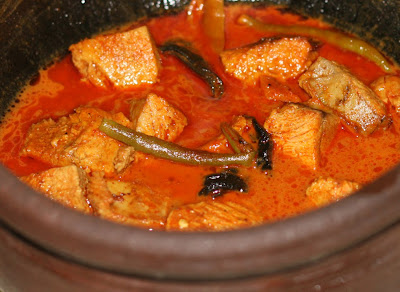

Courtesy: Rosmi Thomas Koottunkal
Ingredients:
1. Fish (Preferably boneless) - 12-15 medium pieces
2. Chilli Powder: 2-3 Tea spoon
3. Turmeric Powder: 1/4 Tsp
4. Ginger: 1 Piece (1 inch) crushed
5. Green chilli: 5 Nos
6. Garlic: 4-5 cloves
7. Salt to taste
8. Coconut Oil: 2 Tsp
9. Curry Leaves - 1 stalk
10. Kudampuli (scientific name: Garcinia cambogia) - 2-3 pieces
Preparation:
Saute Ginger, green chilli, curry leaves and garlic in the coconut oil (preferably in an earthen pot). Soak the powders to a paste and add them. Saute for 30 seconds (take care not to burn the mixture). Add 1 cup (250ml approx) of water. Add kudampuli, fish pieces and salt. Cover and cook until clear coconut oil settles on the surface.
1. Fish (Preferably boneless) - 12-15 medium pieces
2. Chilli Powder: 2-3 Tea spoon
3. Turmeric Powder: 1/4 Tsp
4. Ginger: 1 Piece (1 inch) crushed
5. Green chilli: 5 Nos
6. Garlic: 4-5 cloves
7. Salt to taste
8. Coconut Oil: 2 Tsp
9. Curry Leaves - 1 stalk
10. Kudampuli (scientific name: Garcinia cambogia) - 2-3 pieces
Preparation:
Saute Ginger, green chilli, curry leaves and garlic in the coconut oil (preferably in an earthen pot). Soak the powders to a paste and add them. Saute for 30 seconds (take care not to burn the mixture). Add 1 cup (250ml approx) of water. Add kudampuli, fish pieces and salt. Cover and cook until clear coconut oil settles on the surface.
Out of the mouths of babes and sucklings…
The other day I was watching ‘Nammal Thammil’ (‘Between Us’, to translate roughly) an interactive talk show on Asianet TV. This is a popular program in Malayalam television, and for many years it has held its place against competition. The USP of the show is the host himself, the very likeable, self-deprecating, Mr. Srikantan Nair, whose mannerisms are now staple fare for the mimicry artists in Kerala. I understand he is a top official in the Asianet TV (MD?).
Normally, the Nammal Thammil participants are divided into three groups. The first group consists of representatives of a particular professional category, such as aspiring playback singers, TV Actresses, magicians, astrologers, and even, hold your breath, contract killers in face-masks as was the case on one famous occasion. The second group is made up of experts from the media or social organizations/ agencies, who generally act as interlocutors of the first group. The third group is the audience in the studio, whose members chirp in with debating points, or rather sharp opinions, from time to time. Mr. Srikantan Nair is the fulcrum around which the whole show moves, and it is quite interesting to watch how he manages the balancing act, literally running between the three groups.
On this particular day the first group was made up of participants from another Asianet show for young singers, ‘Munch Star Singer’. Before you start thinking this is about the culinary habits of cannibals, let me hasten to clarify- ‘Munch’ is a biscuit company who sponsors the show, and hence the somewhat weird sounding caption. In the second group were the proud and adoring parents of the main protagonists of the show. They sat there, their eyes fixed on the respective offsprings, ready to defend the progeny at short notice. But these kids did not need to be defended.
‘Munch Star Singer’ (hereinafter described as MSS) is the junior sibling of another mega show on Asianet TV, ‘Idea Star Singer (ISS)’, a show sponsored by the Idea Cell-phone company the contestants of which come from the age group 16-25 years. MSS is for kids, but of course, it is as fiercely contested as the ISS, with the usual exultations, heartbreaks, and tears, around which these reality shows on television are built and TRPs earned.
The MSS contestants have been brought to this special edition of Nammal Thammil. A first look at the participants is somewhat a shock for me. The contestants are not merely young, a few of them are almost toddlers, or so they look. Some of them even speak with a pronounced lisp, may be the result of parental pampering. The Nammal Thammil show seems like a recess for these kids from their regular work (which is MSS). The kids are a handful for the otherwise able Srikantan Nair. He looks out of his depth trying to get his grip on them. They sit there on the stage in deep chairs, their heads barely rising above the backrests. They are a boisterous lot, totally uninhabited, which is again unusual for kids in this part of the world. It is clear these kids have been exposed to the glare of public attention from a very young age. They are able to keep up a continuous banter with each other and with the anchor, and also with the audience.
The show also had the kids singing their favorite songs. They look so young and vulnerable and speak in children’s voices, but when they start singing they become different persons. The songs the children render are difficult compositions originally sung by experienced singers, some of them in their fifties and sixties. The voices of these children undergo a transformation when they sing these songs. They sing in almost adult voices, which I find somewhat frightening.
I have been a listener of songs in many languages by legendary singers for many years. When I listen to the songs of KJ Yesudas sung in the 60s, his voice has an endearing vulnerability of the post-teen. As you listen to his songs over the following decades you can feel how his voice is evolving and maturing with age. It is a long process, and his voice reaches its full-bodied flow at the end of 80s. But when I listen to these children I immediately realize they sound, or they want to sound, like adults. There is obvious talent on display, but there is something disconcerting too there. I get a feeling that these are like runners who want to begin their race somewhere towards of the end of the track. Not for them the long journey.
They are very media savvy too. The quick repartee, adult wisdom, measured opinions and views fall easily from their lips. I feel the same way when I listen to how the child actors in Hindi movies speak wisdom, though there is a difference- in those movies the child simply mouths the stock dialogues prepared by some crude semi-literate script-writer. But this is real life, the MSS kids are talented, except that they are performing on the terms set by the adult world. The deft turn of phrase, and the songs in the adult voices, are sometimes so natural. I only wish their childhoods are intact.
These kids are gifted.... and I wish they realize their talents in full measure.
Beauty and Terror: Introduction to Pallippuram Lore
For a stranger who wanders into this fairytale land the lush green countryside would seem like an abode of peace and tranquility. It lies under the canopy raised by coconut trees, languorous in the sweaty heat of the summer, playful and inviting when the heat abates and the landscape turns into a riot of colors, and voluptuous and desirable like a bathing nymph when the rains wash and seed the land.
It would seem in this land people have no right to be discontent, no reason for being poor or hungry, no justification for being afraid. A minister from the north (I think Yogendra Makwana) once caused a huge controversy with his casual remark on seeing coastal Kerala that people here had no right to be unhappy or poor when there were an abundance of beautiful women to be wooed and plenty of coconuts to be plucked. Laurie Baker, a true Malayalee if ever there was one, once said this was the only place in the world where people preferred to build their homes under the trees (though it is not true any more). A contented people living in peace with the nature. That is the picture.
But this land is just like the nymph of the lore, full of beauty, passion and caprice. Terror is an inseparable part of anything so unfathomable. If you had lived and belonged here, you will know this: the land broods. Fear of the unknown, of the dark forces, of the lurking menaces of netherworld, is an inseparable part of the lives of its people. The fear lives on in its lore, its legends, and its interpretations of reality itself.
In a village in the interior of costal Kerala, one grows up imbibing the beauty and grace of its nature. It is all around you. The breeze that plays in the groves, the coconut trees swaying in the wind, the tranquil waters of the lagoons caressing the land in gentle waves, the network of canals and waterways that quicken the vegetation and sustain the greenery, the paddy fields snuggling close to the white motherly hills, the sunsets that turn the blue into gold. Peace pervades the mind. But peace is hardly a catalyst for creativity. Mind wanders beyond the beauty of this reality and invents dark fears.
Objects of beauty and grace become ominous symbols of fearful supernatural elements. There is a manic frenzy in the growth of the vegetation. Weeds and grass overrun the land and it turns a dark green. Tangle of weeds and bushes overgrow village paths. Dangers lurk underneath. The narrow paths turn into corridors of shade when the trees from both sides grow and meet above, shutting out the sun. One is afraid to walk there. There is uncertainty there.
After the sunset the lagoons present an eerie vista. The steely gray of the backwaters has a menacing look. An evil spirit broods there under the dirty sky. As you sit there longer, what at first seemed like only melancholy becomes an apprehension of something malignant. It is in the air. The last crow hurried home. The sky is empty. The trees lean close to the water. Their reflections have vanished. Now there is only a glittering darkness in the water where earlier those reflections moved with the breeze. Evil spirits are awakened from their slumber. They are moving in. The trees are their abode. It is dangerous to sit under those trees at that time. The oppressive atmosphere paralyses the soul.
With the rains come the thunder and the lightning, like malevolent warriors traveling across the sky flaunting their multi-pronged weapons. The gentle swaying of the coconut trees becomes an ominous dance macabre, and the medusa-like heads of the trees swing madly in the wind. The wind howls and screeches through the trees like a banshee, slashing at everything in sight. When darkness falls there is no let up, the dance macabre continues. The rain pounds on the window panes. Something crashes to the ground and there is the cry of an animal, almost inaudible in the howl of the wind. A bolt of lightning throws the fury of the elements outside into stark relief. Silvery ropes are tied across the tops of the trees and some invisible hand pulls at the tangled ropes. There is fear outside the windows.
But the most terrible, heart-constricting fear is in the moonlight. Especially if you are a lonely wayfarer in the night. The distances look unconquerably long. Like a leprous patina the moonlight lies on the hills. Those white hills are special to Pallippuram. They are made up of ‘silica sand’ and are probably the whitest natural objects in the world. In the daylight they looked like heaps of milk powder. Now they are heaps of crushed bones, bleached to their whitest. In the moonlight they look a bluish white though, an eerie bluish white. They sit there in the moonlight, there is one of them every hundred meters or so. The moon is bright, but these hills have no shadow. That itself is frightening. They loom huge as you approach them. And once you pass them, you are afraid to look back. There is a scraggly looking tree just on the side of the large hill, and a pale shadow of the tree lies on the hill. The silence! the cursed silence is like a heavy burden laid across your heart. And when you look ahead you see that shadowy wavering form approaching from the distance. It cannot be human. Your legs feel like they were cast in iron, and your heart pounds. There is uncertainty and fear.
Given Beauty, human mind will invent the opposite, Fear. Fear is the primal element of human psyche, and it is not hope but fear that enables men and women to conduct their lives. Apprehension, fear, uncertainty. These are the three emotions that lie at the roots of creativity. Human life is a continuous effort to make the future safe, and creativity is its tool. Safe for what? Safe for human life! This seems like incestuous logic, a paradox. True, but life is a paradox too.
It would seem in this land people have no right to be discontent, no reason for being poor or hungry, no justification for being afraid. A minister from the north (I think Yogendra Makwana) once caused a huge controversy with his casual remark on seeing coastal Kerala that people here had no right to be unhappy or poor when there were an abundance of beautiful women to be wooed and plenty of coconuts to be plucked. Laurie Baker, a true Malayalee if ever there was one, once said this was the only place in the world where people preferred to build their homes under the trees (though it is not true any more). A contented people living in peace with the nature. That is the picture.
But this land is just like the nymph of the lore, full of beauty, passion and caprice. Terror is an inseparable part of anything so unfathomable. If you had lived and belonged here, you will know this: the land broods. Fear of the unknown, of the dark forces, of the lurking menaces of netherworld, is an inseparable part of the lives of its people. The fear lives on in its lore, its legends, and its interpretations of reality itself.
In a village in the interior of costal Kerala, one grows up imbibing the beauty and grace of its nature. It is all around you. The breeze that plays in the groves, the coconut trees swaying in the wind, the tranquil waters of the lagoons caressing the land in gentle waves, the network of canals and waterways that quicken the vegetation and sustain the greenery, the paddy fields snuggling close to the white motherly hills, the sunsets that turn the blue into gold. Peace pervades the mind. But peace is hardly a catalyst for creativity. Mind wanders beyond the beauty of this reality and invents dark fears.
Objects of beauty and grace become ominous symbols of fearful supernatural elements. There is a manic frenzy in the growth of the vegetation. Weeds and grass overrun the land and it turns a dark green. Tangle of weeds and bushes overgrow village paths. Dangers lurk underneath. The narrow paths turn into corridors of shade when the trees from both sides grow and meet above, shutting out the sun. One is afraid to walk there. There is uncertainty there.
After the sunset the lagoons present an eerie vista. The steely gray of the backwaters has a menacing look. An evil spirit broods there under the dirty sky. As you sit there longer, what at first seemed like only melancholy becomes an apprehension of something malignant. It is in the air. The last crow hurried home. The sky is empty. The trees lean close to the water. Their reflections have vanished. Now there is only a glittering darkness in the water where earlier those reflections moved with the breeze. Evil spirits are awakened from their slumber. They are moving in. The trees are their abode. It is dangerous to sit under those trees at that time. The oppressive atmosphere paralyses the soul.
With the rains come the thunder and the lightning, like malevolent warriors traveling across the sky flaunting their multi-pronged weapons. The gentle swaying of the coconut trees becomes an ominous dance macabre, and the medusa-like heads of the trees swing madly in the wind. The wind howls and screeches through the trees like a banshee, slashing at everything in sight. When darkness falls there is no let up, the dance macabre continues. The rain pounds on the window panes. Something crashes to the ground and there is the cry of an animal, almost inaudible in the howl of the wind. A bolt of lightning throws the fury of the elements outside into stark relief. Silvery ropes are tied across the tops of the trees and some invisible hand pulls at the tangled ropes. There is fear outside the windows.
But the most terrible, heart-constricting fear is in the moonlight. Especially if you are a lonely wayfarer in the night. The distances look unconquerably long. Like a leprous patina the moonlight lies on the hills. Those white hills are special to Pallippuram. They are made up of ‘silica sand’ and are probably the whitest natural objects in the world. In the daylight they looked like heaps of milk powder. Now they are heaps of crushed bones, bleached to their whitest. In the moonlight they look a bluish white though, an eerie bluish white. They sit there in the moonlight, there is one of them every hundred meters or so. The moon is bright, but these hills have no shadow. That itself is frightening. They loom huge as you approach them. And once you pass them, you are afraid to look back. There is a scraggly looking tree just on the side of the large hill, and a pale shadow of the tree lies on the hill. The silence! the cursed silence is like a heavy burden laid across your heart. And when you look ahead you see that shadowy wavering form approaching from the distance. It cannot be human. Your legs feel like they were cast in iron, and your heart pounds. There is uncertainty and fear.
Given Beauty, human mind will invent the opposite, Fear. Fear is the primal element of human psyche, and it is not hope but fear that enables men and women to conduct their lives. Apprehension, fear, uncertainty. These are the three emotions that lie at the roots of creativity. Human life is a continuous effort to make the future safe, and creativity is its tool. Safe for what? Safe for human life! This seems like incestuous logic, a paradox. True, but life is a paradox too.
Fishing at Pallippuram

Cherthala is one of the most beautiful places on the earth for two reasons - its affable people and its sprawling backwaters, the Vembanadu Kayal.
Fishing in the Vembanadu Kayal was a ritualistic pastime for us children and livelihood for others. Early mornings, we went to the lake shore carrying fishing rod made of green bamboo stalk (Illikkana) and earth worms or smoked Tapioca (Chutta Kappa) or wheat bread (Godamb Appam) for fish bait. With no breeze and noise, the tranquil lake rested in the mornings reflecting the thousand coconut trees on its bank and us with fishing rods. It would remain so for about two hours until the wind starts blowing gently. This was the best time for fishing.
 On Sundays and holidays, some of us (equipped with better fishing tools) continued fishing throughout the day. We went to the shallow streams that reach out to the lake and fished there. We used a variety of fishing tools that suited the nature of the stream. These were Vattavala, ottaal, veeshuvala, koruvala, pokkuvala etc.
This November I had the chance to witness such a fishing session in progress at Pallippuram. I saw two determined young men fishing in a nearby stream against all odds. They had a custom made fishing net resembling a Vattavala, but without the rim. It had a long tail instead of the typical short one.
Here are the pictures! (Photo Courtesy: Bobby Mathews)

Preparing the Net
 Patience.. Wait.. Wait..
 Time for a check ..
 Let's See..
 Not a good catch.. but ok for one curry
A return trip to Thycattusserry
My recent visit to Thycattusserry has been refreshing and rejuvenating. It brought back the vivid pictures of schooldays and childhood.
Click here for a short narration in Malayalam ....
Click here for a short narration in Malayalam ....
Four Types of Mosquitoes
According to behavior and appearance, Aleykutty Varghese Koottunkal (AVK) says, we can classify mosquitoes into four distinct classes:

Ezhukuntham Kotha (Lady Lancer): This species derives its first name (Ezhukuntham) from the long slender legs that resemble spears. Its feminine characteristics are quite visible from outside, hence the second part of the name (Kotha).
Edangetti Chacki (I pick the Vulnerable Spot ): To identify this species is very easy. If you experience a mosquito-bite on a spot where your hands cannot reach out, no matter how much ever desperately you try, you can be of 100% sure that it is an Edangetti Chakki. They know your Achilles' Heel, and are quite daring to publish their presence by delivering a high-pitched music and giving you a painful injection. By the time you device a way to reach her out, she would fly-off with a stomach full. The name Chacki also is reminiscent of the cat, who plays around your legs causing inconvenience and irritation.
Chenchola Rani (The Queen in red garb): The very name reminds me of those red clothes worn by Hindu and Buddhist temple priests. If you see a mosquito with a transparent belly loaded with blood, no doubt, you have spotted a Chenchola Rani.
Chena Chorichi (the Allergic Yam): Have you ever experienced rashes due to handling of the tuber, Yam (Chena). You will have the same experience, if bitten by this species of mosquito. For a long time, post the bite, you will go on scratching the skin.
The most dreaded among these, according to AVK, is the Edangetti Chacki for its dreaded music, which is worse than that of a local musician at Pallippuram we dare not listen to.
So, forget all you have learned about mosquitoes in school. The new (old?) definitions are in.
Subscribe to:
Posts (Atom)